QUANTUM EATING
The Ultimate Elixir of Youth
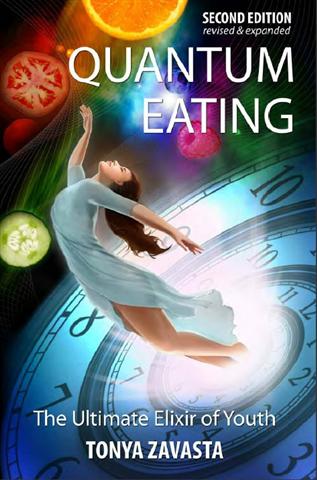
Quantum Eating is the gate to health and longevity. Questions about aging which have baffled thinkers and scientists for centuries are answered in clear, straight talk mingled with attainability and hope. This truly mind-energizing book is filled with fresh insights that challenge our most basic assumptions.
Here are the ready-to-use secrets on acquiring superior health and a youthful glow, while avoiding the unattractiveness of aging.
Quantum Eating is 450 pages!
Tonya, I want to say how much I loved your book: this is by far the best of your books! I am amazed at your ability to use wit, humor, and word plays in English though it is not your native tongue. Most of all, I really thought there was not much else for me to learn about raw eating! But I got a real paradigm shift from your writing about 'heavy water.' You have indeed dared my husband and I to take this raw diet to a higher level!!!
— Susan Schenck, author of The Live Food Factor
Wow! Quantum Eating is amazing! One of the best books on raw foods and living life simply and most healthfully. You are a sheer genius. I am recommending Quantum Eating to absolutely everyone. Congratulations on your research and insights! Would it be alright if I quote you on a couple of things, like the circadian rhythms and perhaps dry fasting?
— Karen Ranzi, author of Creating Healthy Children
This book addresses vital, fascinating topics: the quantum body we occupy ... raw foods as concentrated sun energy ... the circadian rhythms of vital organs ... should we sun-block the sunlight ?... breathing for optimum weight ... oxygen therapies ... and many more. It explains how you can be malnourished while eating a lot of healthy foods, how you can be dehydrated while drinking a lot of water, how you can be shortening your life by using certain supplements and how you can be aging your body by eating at night. This book is candid, intimate, and intellectually illuminating - on the very edge of new science.
I have been glued to your new book! I have read your first two books as well. This new one is sooo cutting edge! I don't want it to end and will read again when I finish. I have been about 95% raw for about 2 years and I guess have not gone completely 100% because I am still cooking for my family. Your writings have been such an inspiration to me and I really sense your passion for this lifestyle. I am excited to start implementing what I have learned from Quantum eating!
— Marissa Valdez
I just finished reading "Quantum Eating", and am now re-reading it out of sheer fascination with the quality of information there. It is truly a masterwork with intriguing ideas and should be required reading for every raw-fooder out there. I found the caliber of your information outstanding and of great use. So many raw-food books repeat things that most of us already know. But your book repeatedly broke new ground.
— Starr Spencer
Quantum Eating exposes the limits of the mechanical thinking and materialism that dominate most modern anti-aging research. Quantum Eating is about stepping away from a three-dimensional view of the human body and into the multi-dimensional world of healing possibilities. It offers rare optimism about aging. An easy, natural "elixir of youth" can be achieved without being a slave to traditional medicine.
Quantum Eating Works: Live Blood Analysis Before and After! Read the whole story here.

Tonya’s new edition of Quantum Eating is a detailed book. It’s a quirky, intelligent, funny, sassy, entertaining and informative read, that will make you think and inspire you a great deal. There’s nothing more lovely than curling up with this book and learning about how quantum physics is linked to your everyday life and how you think ... Read the Full Review Here ...
— Review by Jessie Maguire of Funky Raw Magazine
Life is a grand adventure. This book offers a way for us to reach for an optimum level of well-being in order to live the grandest life we can. Pour these new ideas into the chalice of your life, and watch it overflow with pure joy and vitality!
Dear Tonya, after receiving your latest book 2 weeks ago we started our quantum eating plan. Over the past 21 months we thought raw food was absolutely amazing so we naturally progressed to quantum eating ten days ago. We are sleeping better and both of us have even more energy. Even our skin is smoother and a body that is slender. It is like quantum eating has taken us into a parallel world of no sickness or aging, clarity of mind and even more tolerance of others. People are drawn to you with a fascination of who you are which is a really great compliment to the raw lifestyle. Thank you so much Tonya for making us see that what we thought was the real world (full of disease and sickness) was just for fools but the quantum world is for the spiritual and forever young. Yes there is a fountain of youth and thank you Tonya for finding it for us all! Many thanks,
— Susan & Les O'Neill from Australia
Thanks so much again for your book 'Quantum Eating.' I'm reading it very carefully and enjoying it very much. You're a real boon to the raw food movement, and so knowledgeable.
— Kate
I more recently purchased Quantum Eating, and feel obliged to tell you, I think that book is dangerous! Why do I think it's dangerous? Because I'm finding it so intriguing, so informative and enlightening, and so entertainingly written, that I can't put it down, and it's keeping me up past my bedtime!! Every night I tell myself I should put it down and go to sleep, but I have to keep reading "just a few more pages" ... and a few more ... and a few more! I'm enjoying it immensely. It really speaks to me, and I'm loving the new things I'm learning from it.
— R.G.
"Quantum Eating" and other raw food books are available at my Online Beauty Store.
Dear Tonya, you are such an inspiration. Your last book, Quantum Eating is a masterpiece in my view. Your conclusions are so original, and you show the path of how to arrive to the quintessence of health and nutrition. I loved every line, and I am going to read it again. After your book, I got rid of many other health books.
The beneficial effects of trying your views were immediate. I have been plagued with insomnia for years, and then suddenly after starting your juices, I recovered my normal sleeping patterns. Also, I feel happier, with a tendency to sing and dance. Your recipes are the best. I love their simplicity and at the same time greatness!
— Ana
I read your recent book. It has very much helpful information. I think it is brilliant. I can see how much research you did and how much hard work you put into it. I also can see that you read huge amount of books about health and raw lifestyle.
— Mela Marsh
Your new book is the best one I have read so far - and I think I've read them all! Thank you so very much! — Pam Hatfield
I am reading Quantum Eating for the second time. That book is amazing - one which I need to read many, many times to understand more fully all of the layers contained within its pages. Thank you for writing that book and putting it out into the world!!
— Rosemary
While I'm not yet finished reading your hefty tome, Quantum Eating, I wanted to let you know how fascinating I'm finding the book. I'm so pleased that there's someone who is conducting independent research and not rehashing the same old, unproven theories. I attended one of your lectures in NY last year and you were very inspiring. Thank you for all the wonderful and groundbreaking work you're doing.
— Susan Marmol
Thank you very much for your new book. I can't seem to put it down with all the wisdom written on its pages.
— Carol Henegan
I've just finished reading your book, Quantum Eating and enjoyed every single page of it. Was most disappointed when I did read the last page, as I knew I would be hard pressed to find a new book to start on that would be anywhere near the calibre of Quantum Eating. I sincerely hope there will be many more books to come from you.
— N.D.
I have just completed reading your new book and it is terrific - I have learned so much and it will be referenced often (just as my other two books by you are). Blessings to you and your work and thank-you for so beautifully leading the way.
— Shannon
Surely a book to absorb at multiple levels and to both reference and re-read! Thank you!
— Elizabeth Severino